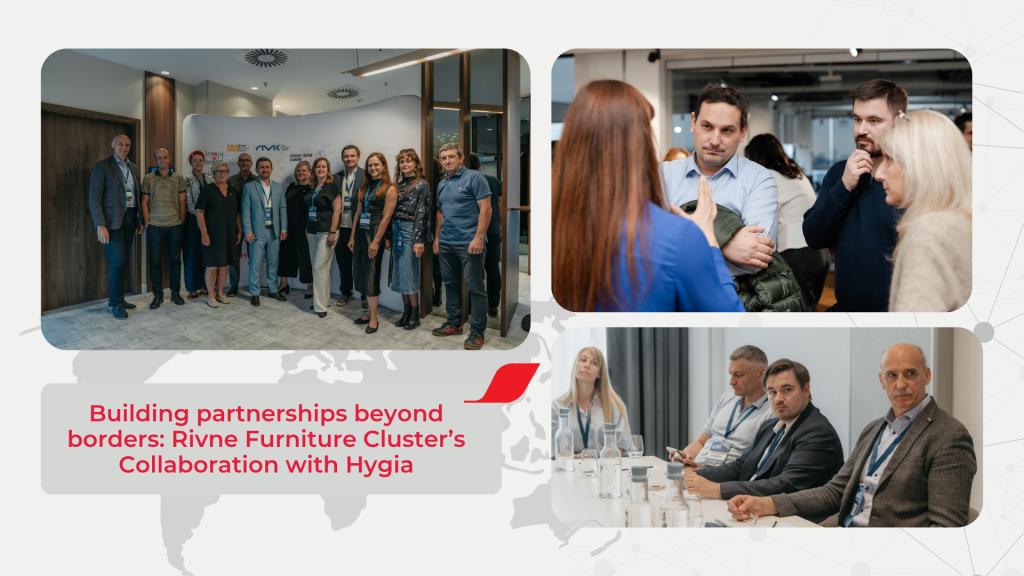
More than three years ago, a visit to Cluj-Napoca marked the beginning of a long-term collaboration between Hygia and the Rivne Furniture Cluster.
As a partner in the reBUILD project and part of the GO Furniture Meta-Cluster initiative, the Rivne Furniture Cluster plays an active role in strengthening connections between Ukrainian and European organizations through cluster development, regional cooperation, and international partnerships.
Bringing together companies, professionals, and institutions from the furniture and woodworking industry, the cluster fosters innovation, collaboration, and sustainable regional growth. By connecting manufacturers, designers, researchers, and local stakeholders, it supports stronger regional cooperation and helps companies navigate the challenges of today’s business environment.
The interview with Andrii was conducted during the reBUILD UP-SKILLING Exchange in Cluj-Napoca (9–11 February), which brought together SMEs from Spain, Slovenia, and Ukraine for a series of learning and networking activities. Within this context, we spoke with him about his experience working with the Hygia team, the value of international partnerships, and the role of European cooperation for Ukrainian businesses.
“Networking is everything.” Below, you can read a more detailed perspective on his collaboration with Hygia, from his first visit to Cluj-Napoca to the experience of working together within the reBUILD project and the broader European partnership ecosystem.
Q: How did our collaboration start?
A: I believe it started three and a half years ago. I was invited for a visit to Romania. And for me it was a random visit to a random cluster in Europe. Of course, I was happy to come because we needed knowledge and experience on how to develop a cluster. At that time, it was only a society of companies without projects, without a strategy.
Then I was invited to the Transylvanian Furniture Cluster*. I came and stayed here for two weeks, meeting many companies and the whole team.
*Editorial note: Hygia is responsible for managing Transylvanian Furniture Cluster.
Q: What about the reBUILD project? How did it start and why did you decide to get involved?
A: The project really started from that trip I made three and a half years ago, because I met the team, we introduced ourselves to each other, and then Andreea (Project Manager at Hygia) invited me to join the project. It was about Ukrainian clusters being included in European supply chains and so on.
Of course, I read the project description, we discussed it, and we happily agreed to join. We are very grateful for the invitation. We submitted the project, we got it, and now we are implementing it.
Q: How would you describe the collaboration with Hygia?
A: Overall, it was a very good experience, an experience where you felt included. As feedback, I would probably even use the word magical, because it was better than good, better than expected. Every time I visit Cluj,and this is my third time, I feel at home.
This time, while travelling from Istanbul to Cluj, I kept thinking: ‘When will I finally be in Cluj?’ because I know I will meet so many friends here.
Hygia is an exceptionally good team in terms of everything: expertise, atmosphere, welcoming atmosphere, and support. From the highest level to the lowest, everyone is very friendly, warm, and really willing to help.
During the whole working process, implementing the project, reporting, and so on, I also felt a lot of support, because this is our team’s first big European project. Before that, we had a USA project, but it was different. European reporting is more challenging.
Working with Hygia has been exceptional for us because we had the opportunity to gain new experience from such an experienced team. So yes, it’s magical.
Q: You were also involved in the New European Bauhaus application. How was that experience for you?
A: It was also very good. At that time, we submitted two projects within only a couple of months, and we had a lot of internal communication with the regional government, the city of Rivne, companies, and different clusters. One of the projects was developed together with the city, so we tried to understand which fields needed the most focus in the region, because obviously, we care deeply about regional development.
We also communicated with our partners in Leipzig, who were applying to the project as well. Working more with international partners is very useful for us.
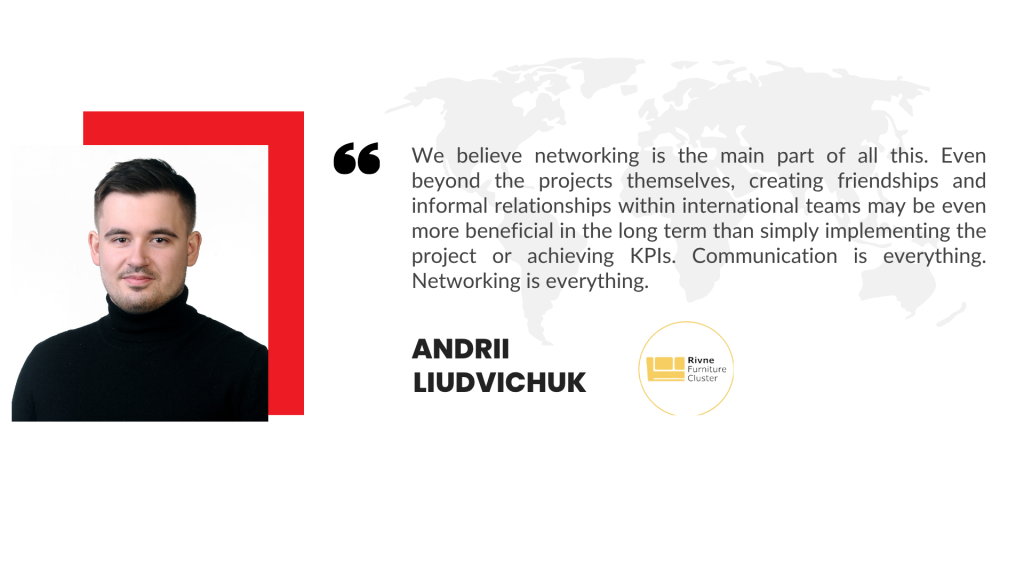
We believe networking is the main part of all this. Even beyond the projects themselves, creating friendships and informal relationships within international teams may be even more beneficial in the long term than simply implementing the project or achieving KPIs. Communication is everything. Networking is everything.
Q: Looking back, which project did you enjoy the most?
A: I would say both the Meta-Cluster and reBUILD projects, because again, it all comes back to networking, not only between clusters, but also between companies.
Unfortunately, this time our companies could not join because of the conditions in Ukraine, but they previously visited Cluj and later Ljubljana, and I believe they will also go to Bilbao. For Ukrainian companies, the feeling that they are not alone, that they are supported, is probably the most valuable thing ever.
All the networking and communication have been extremely valuable, even online. Through these projects, we created communication between European companies and Ukrainian companies, and our companies gained experience in how to conduct B2B meetings, something many of them had not experienced before.
Through projects such as reBUILD and the GO Furniture Meta-Cluster initiative, the collaboration between Hygia and the Rivne Furniture Cluster has grown beyond a traditional project partnership. What started as a first visit to Cluj-Napoca evolved into a long-term collaboration built on trust, knowledge exchange, and shared commitment to supporting innovation and international cooperation in the furniture sector.
For Andrii and the Ukrainian partners involved, the experience was not only about project implementation, but also about building meaningful connections, gaining new expertise, and creating opportunities for Ukrainian companies to engage more actively with the European ecosystem.